Clearing: A Resource Journal of Environmental and Place-based Education
2012 Compendium © Creative Educational Networks
Plants and People
Three service learning teams tackle teaching children about the ecological and cultural importance of native plants
by Kathryn Lynch
University of Oregon 2012
 alal! Salmonberries! Sword ferns! The Northwest is home to a great number of native plant species that humans have used for centuries. Sadly, many local children are unaware of the history and culture connecting people and plants. Yet, from the beginning of time, plants have provided us food, medicine, and material for clothing, shelter, transportation, decoration, spiritual practices and so much more. And people today from diverse cultural, ethnic and economic backgrounds continue to gather plants for a broad range of reasons. Unfortunately, these relationships are often invisible or obscured in our modern world – or only discussed in history lessons, so that children are unaware of the current living bond they have with the plant world. This is a missed opportunity. As Sobel and Louv and others have argued, children must first love the natural world if they are to be motivated to protect it, and they develop that love through direct, personal connections.
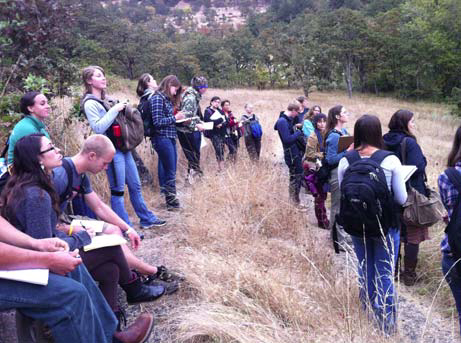 In response, the Environmental Leadership Program (ELP) at the University of Oregon launched a year-long “Plants and People Initiative.” The ELP is an interdisciplinary service learning program housed in Environmental Studies. It is designed to provide undergraduates with an integrative capstone experience and graduate students experience with project management. As a service-learning program, these experiences are developed within the context of providing meaningful service in the community – and in our case, addressing environmental issues our community faces. In 2011-2012, three teams took on the challenge of developing environmental education materials focused on “Plants and People” to help children recognize both the ecological and cultural importance of native plants.
To prepare the undergraduates for their service projects, we offered a new course, “Pacific Northwest Ethnobotany” in the Fall of 2011. In this interdisciplinary course we looked at the ancient gathering practices of Native Americans, the introduced plants and traditions of immigrants, and the emerging practices of current residents seeking to reconnect with the natural world. We investigated the complex economics, multi-faceted politics, and diverse cultural traditions associated with gathering wild plants. We examined how plant biodiversity is currently being tapped to promote both conservation and rural economic development. Each student created three plant profiles, which resulted in the creation of a Northwest Ethnobotany Field Guide (Bonady, 2012). These profiles include identification information, extensive ethnobotanical information, and creative writing, art, and photographs.
(Available for download at: https://sites.google.com/site/plantsandpeopleelp2012/phases-of-theproject-1/northwest-ethnobotany)
This course fed into the winter term course, “Environmental Education in Theory & Practice” where students practiced developing engaging environmental education for K-8 students focused on native plants and their human uses. Participants gained a working knowledge of best practices in EE through readings, guest lectures, field trips, and most importantly, their service-learning project in which they developed educational materials for their community partners. The “Stalking the Wild Camas” team worked in partnership with Mt. Pisgah Arboretum to develop field trip quests for fifth graders. These fun, educational treasure hunts were designed to inspire curiosity about the native plants used for food, healing and cultural materials. They also facilitated an “Art in Nature” workshop at the Arboretum Wildflower Festival. The “Canopy Connections” team developed and facilitated field trips for middleschoolers that included a canopy climb, cedar bark dyeing, and scavenger hunts, among many other activities about native plants and their cultural importance. The “Exploring Ethnobotany” team developed and implemented a “Plants and People” curriculum for Adams Elementary School. They also installed a native plant garden to support hands-on learning about the plants.
While the specifics of their curricula were left up to the teams to determine, all teams
were required to:
1) incorporate an interdisciplinary approach,
2) include multi-cultural perspectives,
3) use experiential, inquiry-based methods,
4) promote civic engagement, and
5) articulate assessment strategies.
Their materials were pilot tested at the end of winter term and then the teams worked with their community partners to implement their EE programs throughout spring term. Each UO student completed approximately 120 hours of service, which entailed facilitating field trips, classroom visits and developing supplemental educational materials (e.g. websites, presentations). What follows next are descriptions of the projects, written by the team members themselves.
Case Study 1. Questing: Bringing Plants, People, and Adventure Together
By Kaya Berry, Kim Berry, Paul Metzler, Laura Vuoso, with support from the rest of the team which included Hazel Cran, Samantha Edmonds, Lauren Gedlinske, Jillian Hollis, and Mahala Ray, with Devon Bonady (graduate project manager).
Games such as Zelda and the Oregon Trail have instilled a spirit of adventure in our nation’s youth. Furthermore, they have allowed children to gain decision-making and problem solving skills without leaving their seats. However, there is something missing, something that a child can only find by exploring the variety of “loose parts” in nature and engaging his or her senses in the complex natural world (Louv 2006). Questing bridges the gap between a child’s sense of adventure and an authentic outdoor experience. Children today spend so much time having virtual experiences and so little time outside that they are becoming disconnected from their local environment. Direct experiences in their local environment give children the opportunity to form a sense of place, which in the long run encourages attitudes and behaviors that will promote conservation. We are the generation that came inside to play Oregon Trail on computers. Now, we need to teach the next generation that getting out on a real trail can be even more exciting.
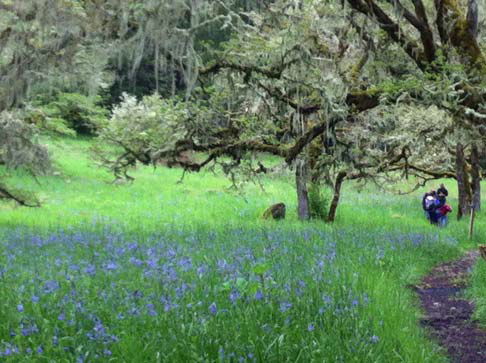 Our team of nine students was given the opportunity to work with Mount Pisgah Arboretum (MPA) to develop and implement field trips to educate fifth grade students about the relationship between plants and people. MPA is dedicated to conserving native habitats including the oak savanna which has all but disappeared since European settlers arrived in implement a plants and people field trip – coniferous forests, oak savanna, and riparian areas are all represented and easily accessed, and these habitats host an abundance of native plants including camas, a staple food of the native Kalapuya people.
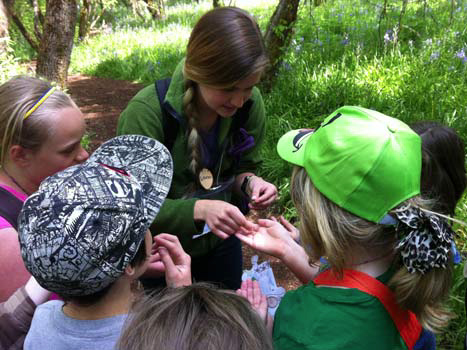
MPA gave us the challenge of developing field trips in the form of quests. A quest is a hands-on learning experience in which participants lead themselves on a journey through nature by decoding clues in order to find a treasure. By tromping around on the trails and following clues, our quests allowed students to explore the uses of plants and engage their senses. Quests are excellent tools for teaching outdoors because students want to see where the clues will take them next and they want to claim the prize at the end of the journey. We researched and practiced the art of creating quests and witnessed the power of connecting students to nature through discovery.
As we designed our quests we incorporated multiple intelligence theory, inquiry, and
constructivism. We tried to engage all students by facilitating a variety of activities that
incorporated all eight types of intelligences. For example, students read different types of clues out loud and used them to identify plants. They also used maps to locate themselves and figure out where to go. They acted out survival situations along the quest. They used their five senses to explore the plants and other natural features at the arboretum. We had discussions as well as
“silent journeys.” We focused on addressing students’ pre-existing knowledge of, and attitudes toward, nature. We listened to what students were saying and encouraged them to take responsibility for their own learning. With the power of inquiry and the magic of questing, we encouraged students to connect with the local environment and inspired them to further explore their essential relationship with nature.
During the field trip, the children were divided into small groups of 4-8. We gave each student a name tag with the name of a plant that was to be identified and discussed during the quest. Students were responsible for pointing out their plant throughout the field trip. We went over safety rules and then set up the context for the quest, asking them to imagine that it was 200 years ago, and there were no grocery stores, no malls, no cars, no electronic gadgets and that they needed to work together to survive using what they could find on the trail. Each quest had a different route but covered the same nine native plants. We used wildcard clues and puzzle piece clues to move through the quest. Wildcard clues described an issue or emergency that the group faced and the physical features of a plant that can be used to remedy the situation. For example, the wildcard clue for camas read:
Grumble, grumble. Your stomach is growling and you are hungry! Collect the
bulbs of this plant and roast and store them for the winter ahead and you will be
full and happy until the start of spring!
This plant:
-Has light purple, star shaped flowers
-Is 1 to 3 feet tall
-Has grass-like leaves
-Often grows in sunny areas
Once the students found the plant, we facilitated a discussion using inquiry about the cultural uses of the plant. After each plant discussion, the students were given a puzzle piece. On one side of the puzzle piece was a directional clue that told them where to head next. For example,
From the Riverbank Trail move towards a place where bats like to chill.
After you spot it, be sure to head up the hill!
On the opposite side of the puzzle piece was a part of the treasure map. At the end of the quest, students assembled the puzzle pieces to reveal the complete treasure map that indicated the location of the treasure box. For example,
Now go ahead and cross the creek, there’s one more thing to do.
Head towards the picnic tables so you can prepare for your final clue!
“You are SO close to completing the quest!
Return to the spot where it all began and assemble your map.
Then….GO FIND THE TREASURE!”
The stated mission of our program was to promote awareness of the cultural importance of native plants to people in the Willamette Valley and to inspire fifth grade students to become
knowledgeable stewards of their local environment. By the end of spring term, we had facilitated 7 field trips, reaching over 300 students. Using the framework provided by the Tblisi Declaration, our program focused on the awareness, knowledge, attitudes, skills and actions of fifth grade students. In order to determine whether or not our goals were met we developed a pre and post-test assessment. We evaluated our program based on how well students could identify the ways in which people and plants interact. We looked at how well they could they identify the importance of native plants and native ecosystem preservation. We considered whether they better understood the cultural significance and importance of preserving native ecosystems and native cultures. In the pre-field trip assessment, the students answered an average of 9% of the questions correctly. After the field trip the same students answered an average of 55% of the same questions correctly. We believe that the fifth graders who participated gained an abundance of knowledge about the historic and contemporary uses of various trees, flowers, and shrubs native to this area, and through this, developed a closer connection to their local environment.
And we are happy to report that the field trip will continue to be led by MPA community volunteers/ nature guides in the future. For more information about our project, please see:
https://sites.google.com/site/plantsandpeopleelp2012/phases-of-the-project 1/environmentalleadership-program-projects/stalking-the-wild-camas
Case Study 2: Canopy Connections
by: Sarah Caponi, Carrie Frickman, Ellen Ingamells, Gritz Kuhn, Jake Kurzweil, Emma Newman, Kate
Vannelli, and Shaun Wykes, with Marissa Williams (graduate project manager).
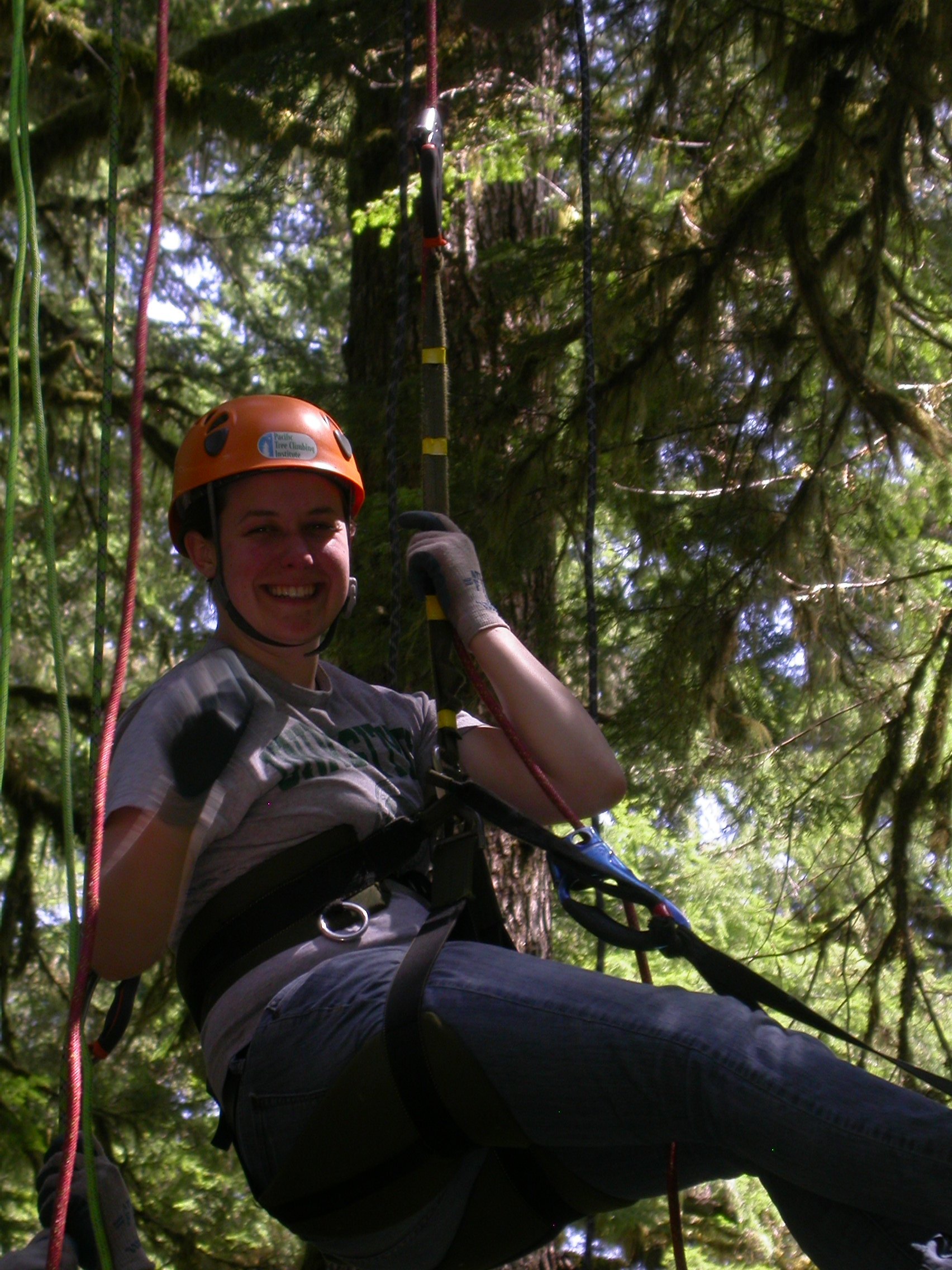 Imagine you are a middle-schooler. Waking up for school, like every morning, rather reluctant, certainly not full of excitement. Then you remember today is the Canopy Connections field trip and your outlook shifts – you are excited and nervous. The bus drops you off at HJ Andrews Experimental Forest.
You are in woods, not the classroom …. life is good.
Your first challenge of the day is to climb a huge oldgrowth Douglas-fir tree. You are thinking “I get to hang out in a tree for class, wow!” You start climbing up the tree like a little inchworm, and you notice that the views are changing, the sounds are different, the air is crisp, the moss species are final treasure. The first clue you encounter instructs:
Open your journals and open your ears
Can you draw exactly what you hear?
With you in the middle and the tree by your side
Make a sound map to use as a guide
Use pictures, or words, or an x to mark the spot
Of everything your ears have caught
Spend 5 minutes mapping and then climb on up
Until you find the next clue that tells you what’s up
And so the day continues, poking around the forest, exploring, asking questions, having an awesome time, working together, clue by clue, to find the final treasures. So, why did we develop this program? The answer is simple. The Pacific Northwest is home to some magnificent old-growth forests. Unfortunately, many local children have never had the opportunity to explore this enchanting ecosystem first-hand. Youth today are spending too much time inside, and thus suffering from what Richard Louv termed “nature deficit disorder”. Children suffering from nature deficit disorder experience separation between themselves and nature, leading to a culture unaware of ecological issues. As discussed by Louv in his book Last Child in the Woods, this disorder has also been linked to attention issues, depression and behavioral problems. This leaves students with inadequate problem-solving skills needed to address current and future environmental issues. In response, Canopy Connections was created. This day-long field trip addresses these issues by taking middle school students on a six-hour educational adventure that helps them reconnect with nature.
Canopy Connections is a partnership that began in 2009 between three organizations. HJ Andrews Experimental Forest provides the site, and is located on the McKenzie River, an hour east of Eugene, Oregon. The mission of HJA is to “support research on forests, streams, watersheds, and to foster a strong collaboration among ecosystem science, education, natural resource management, and the humanities.” This unique site, known worldwide, is a perfect setting to introduce students, some who have never been to an old growth forest, to the unique wonder of the Pacific Northwest natural environment. Our second partner was the Pacific Tree Climbing Institute, who provided the climbing expertise and gear. This organization offers guided tree climbing expeditions specifically in the forests of the Pacific Northwest, and was formed for the purpose of demonstrating the incalculable value of remaining old growth forests. The role of our Environmental Leadership Program team was to develop the canopy and explore the understory. In keeping with the “Plants and People” theme this year, our mission was specifically to inspire curiosity about the many local native plants used for food, medicines and materials. We were given the additional challenge of organizing our field trip using ‘questing’. We developed the curriculum materials in winter term and then visited classrooms in April, and lead full-day field trips every Thursday and Friday throughout the month of May. Our goal was to create a transformative experience for the students.
Questing takes students on an interactive journey where clues are followed to an end treasure. The quest is a like a pocketknife for any facilitator. It can address multiple learning intelligences and is easily adapted to any situation. And perhaps most importantly, questing requires active participation. This appealed to us after having read bell hooks’ work on engaged pedagogy. We wanted to address student growth in a holistic sense. We sought to facilitate academic development, but also personal, interpersonal, physical, spiritual and mental skills needed to be a productive member of our changing world. We engaged the students by setting a positive, passionate tone and created a safe, open and non-judgmental learning environment.
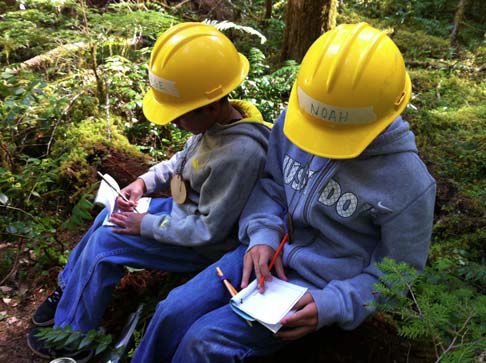 Students were divided into four groups and rotated through four stations throughout the day. During the first quest students sketched plants, created plant rubbings, dyed cloth with cedar bark dye, and drank Douglas-fir tip tea. The next quest, entitled “CSI: Cameras, Science and Investigation” encouraged students to explore patterns in the environment while also learning about the ecological role of nurse logs in an old growth forest. The next quest, “Forest Foragers,” explored the complex economics and politics surrounding gathering practices today. This quest highlighted the diversity of people who still rely on the forest for food,medicines and cultural materials. And during the much anticipated tree climb station, students climbed 90 feet into an old-growth canopy, giving them a new perspective on nature aimed to inspire reconnection and empathy for our natural world. Throughout the day we focused on common and easily identified plants with important cultural uses, either to the Kalapuya, the indigenous tribe native to this region, and/or to current residents in the area.
These plants included Douglas fir, Western red cedar, salal, Pacific yew, sword fern, Western hemlock and Oregon grape. Our hope was that throughout the day, students would gain native plant knowledge as well as a rich understanding of the vital importance of plants to the health and culture of people. In gaining this holistic understanding of the connection between people and plants, we hoped that a deeper connection would be made, sparking a passion for wild and natural spaces and inspiring the generation who will make important decisions regarding the environmental future of our planet. For more information about our project, please see:
https://sites.google.com/site/plantsandpeopleelp2012/phases-of-the-project-1/environmentalleadership-program-projects/canopy-connections
Case Study 3: Exploring Ethnobotany at Adams Elementary
by: Stephanie Loredo, Kelsey Miller and Sierra Predovich, with support from the rest of the
team which included Ryan Bax, Natalie Brockie, Elise Downing, Elizabeth Sanner, Daniel
Sapiro, Mike Strauhal, Carson Viles, Chandler Wherry, with Kelly Sky (graduate project manager).
The Exploring Ethnobotany team developed and implemented a curriculum focused on the relationships between native plants and people for Adams Elementary School. Like the two other teams discussed previously, we aimed to address nature deficit disorder by providing students with knowledge about native plants and motivating them to explore outdoors. Our overall goal was to create an understanding of the importance of the relationships between native plants and people, which we hoped would spark their desire to protect and to learn about native plants and local habitats.
To reach our goal we first planted a native garden on the school premises to support our
teaching. This entailed removing non-native vegetation from around the gym and replacing it with native species. Thanks to the generous donations of several local nurseries, we were able to transform the front of the school into a beautiful living classroom at virtually no cost. This space then supported the lessons, providing a space for the children to ‘meet the plants’ first hand.
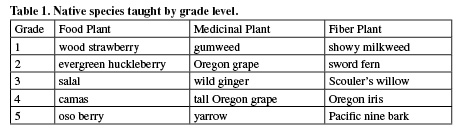
Second, we developed the curriculum. Each grade focused on three important native plants – including one used for food, one for healing, and one for fiber (see Table 1). With this intentional sequencing, new students to Adams will learn the ecological and cultural importance of fifteen plants by the time they graduate from fifth grade. While each grade level participates in different activities, all students learn how to identify their plants, how they are used and prepared, and how they have been and continue to be a part of the lives of local people.
Lesson plans were designed using the theory of multiple intelligences to ensure that activities were engaging and memorable for all students. This theory states that students have different ways of retaining information, therefore teaching to many different ‘intelligences’ will be more effective. Therefore, each of our lessons rely a variety of teaching methods in order to appeal to various learning styles. For example, in first grade we used storytelling, discussion, observation, drawing, painting and hands-on gardening.
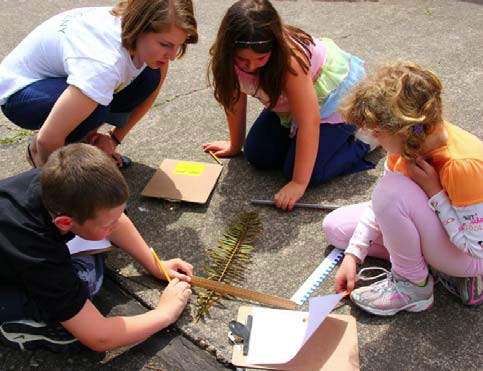 In all grades, students studied their plants by making careful observations and by learning descriptive terms involved in identifying plant species. For example, second graders made measurements of their plants and fourth graders learned how to use a dichotomous key. We also included hands-on activities in all grades. For example, third graders wove willow baskets and made salal bouquets. Fifth graders made a yarrow poultice and dyed clothing using osoberry dye.
Additionally, each grade level spent some time discussing stewardship and conservation. For example, students in first grade planted woods strawberry seedlings in the native plants garden. In the second grade students learned how to harvest huckleberry and the importance of harvesting this and other native plants sustainably. Fifth graders discussed how controlled burning by native Kalapuya people allows for many native plants to thrive, as well as how invasive plant species affect the landscape. After each hands-on activity, we made time for reflection. For example, fourth graders first made cordage, followed by a journaling activity in which they were encouraged to think about the importance of oak savannas and prairie habitat to native Kalapuya people. In addition, we also connected our lesson plans to state standards to ensure that the activities were age appropriate and to make it easier for teachers to adopt our lessons in the future.
Our approach in the classroom was greatly influenced by the writings of bell hooks. We were inspired by her description of engaged pedagogy and we strove to put what we had read about into practice. This meant we saw ourselves as “facilitators” rather than “teachers” – with the responsibility to guide discussions by providing the “right” questions, rather than the “right” answers. In this way, the students were active participants in the learning process, not simply passive consumers. By providing the students with questions, we required them to think critically, problem-solve, and work together to come up with solutions. As facilitators we aimed to create participatory spaces for the sharing of knowledge and strove to treat the children we worked with as whole people. Engaged pedagogy is a way of teaching holistically, through body, mind and soul. It requires us as facilitators to be committed to promoting self-actualization in ourselves and in our students, in order to promote well-being and empowerment for everyone in the classroom. We hope this learner-centered approach helped the students feel more involved in the learning process.
Throughout our lesson plans we incorporated the use of inquiry to help draw out the students’ former knowledge. By starting off lessons asking students what they know about native plants, we were able to get a general idea about how much knowledge the students already had and how we needed to modify our lessons. We focused on skills – particularly how to identify plants – and also on how these plants are used across cultures. Lesson activities were interactive, engaging, and varied; making learning both challenging and fun. Lessons began by providing awareness of native plants, issues, and uses, and ended by encouraging students to actively utilize their new knowledge about native plants. For more information about our project, please see:
https://sites.google.com/site/plantsandpeopleelp2012/phases-of-the-project 1/environmentalleadership-program-projects/exploring-ethnobotany
Works Cited
Bonady, Devon, ed. 2012. Northwest Ethnobotany Field Guide.
https://docs.google.com/viewer?a=v&pid=sites&srcid=ZGVmYXVsdGRvbWFpbnxwbGFudHN
hbmRwZW9wbGVlbHAyMDEyfGd4OjVjNWRjOTM0NjZlNzAwYTc&pli=1
hooks, bell. hooks, bell. 1994. Ch. 1: Engaged pedagogy. In Teaching to Transgress. Education as the Practice of Freedom. NY: Routledge. Pp. 13-22.
Jacobson, Susan K, Mallory D. McDuff, and Martha C. Monroe. 2006. Conservation Education and Outreach Techniques. Oxford: Oxford University Press.
Louv, Richard. 2005. Last Child in the Woods: Saving Our Children from Nature-Deficit Disorder. Chapel Hill, N.C: Algonquin Books of Chapel Hill.
Sobel, D. 1996. Beyond Ecophobia: Reclaiming the Heart in Nature Education. Nature Literacy Series. Great Barrington, MA: The Orion Society.
advertisement