
K-12 Activity Ideas:
Monitoring Biological Diversity
by Roxine Hameister
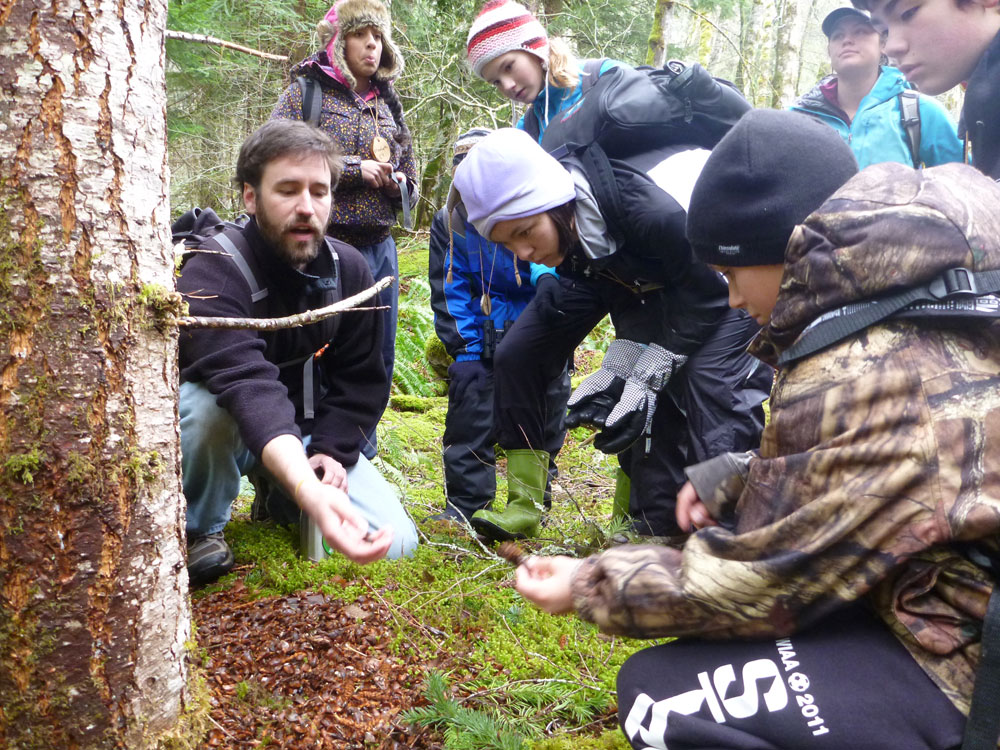
Developing a biodiversity monitoring project at your school can help students develop many skills in an integrated manner. Here are some simple ideas that you can use to get your students started.
Children and teachers are being pulled in many directions. Children want to “learn by doing/’ but because of societal fears for children’s safety, they are very often not allowed to play outdoors and learn at will. Teachers are encouraged to meet the unique learning styles of all students but the classroom reality often means books and pictures rather than hands-on experiences. In addition, children are under considerable pressure to be thinking about their futures and what further, post secondary, education they might be considering.
Sometimes children just like science. Many are of the “naturalist intelligence” and enjoy learning how to classify their world. Activities that meet all these requirements are within schools’ meagre budgets and are indeed possible. These projects are equally possible for the teacher with little science or biology background knowledge. The science skills are readily picked up; being systematic about collecting and recording the data is the main skill needed. The curriculum integration that is possible from these projects range from field studies to computer skills, to art and literature; the entire curriculum is covered in these activities.
Establishing a biodiversity-monitoring project in your school or school district can meet many of these demands. You can do these projects alone, or join “with others in your area and compare data, or you can participate in one of the many national groups that do monitoring or “Watch” type programs. If you are fortunate, and are at the same school for several years, you can compare your own data from year to year. There are others who would like to share the data via the Internet. Just put it out there and see who is interested. The information can be added to your schools web site, or if you are in Canada, you can add it to the Canadian Atlas Project for your community.
Activities such as these are the beginning of an important reflective process for children. Adults have place association or place memories; it is as children that these memories are created. Being part of a project that allows students to participate in scientific monitoring of the community in which they live provides safe opportunities for children to be in nature as well as learning some science skills.
This is not just science. You may include activities that have children draw pictures of the site, make maps of the special places they have found, or write poems or stories based on the site. They can design nature walks for younger children or their parents so they can introduce them to the site. They can draw plans for other uses for the site that will protect its special nature.
The down side of the project, or any monitoring project, is the time commitment. You have to go and make your observations no matter what the school day has thrown your way. This is often difficult and I do not mean just rainy weather. Many schools are fortunate enough to have a natural area nearby that would meet the requirements of the site selection process but other, more urban, schools may feel that they cannot do such a project.
If you are in a completely urban area, with no natural areas, look to do the project on empty lots or other areas that have untended plants growing. The results will be different but interesting. In many urban areas, it is difficult to do the recording of the plant life over several years since the environment can change so very quickly, but similar areas are always available even if the original site is paved over. There are always possibilities, no matter how urban the landscape.
Students develop many skills conducting monitoring projects. The first is problem solving, both on paper and in practical terms. How to get a rain collector to remain attached to a branch is a practical problem that needs to be solved.
The range of intellectual skills students use in such projects is enormous. Classifying and identifying the plants and animals discovered in the ecosystem are two skills that are developed. Next, there is communication through keeping notes in a field book.
There is analysis, inference, and categorizing as part of the scientific process involved in collecting, preparing and testing the samples as well as hypothesizing as to explanations. These skills may well be taught in other classes but this project gives a real situation to use skills that might otherwise have been taught in isolation. This is true integration of the skills and a higher order thinking skill on Maslow’s hierarchy.
The following are very simple ideas as to how to begin some of these projects on your own.
Plant survey
Curriculum objectives:
To study plant diversity using the grid
method.
Material:
Plastic grid frame/ or string and pegs, local topographical maps, plant identification books or field guides, GPS (if possible). Graph paper, clipboards, large classroom base map.
Teacher Preparation:
Before having students visit a site it is helpful if you go over the area first to determine which plants are likely to be found and become familiar with the local landscape. You will be better prepared to review the plants’ names with the class before you go into the field.
Activity:
Create a grid at the selected site. There are two ways of doing this. If you choose to study a small area, you can prepare a frame of wood, or plastic tubing, and string for each student or group. Hula-Hoops, from the gym supply room, also work well for this activity. The second way is to put small stakes in the ground and put string around the stakes. The best size is one meter square if a study of small plants is planned or a larger site if a more general study is going to be taken. The idea is to limit and delineate the area of study. Remember to instruct the students to select an area that is typical of local ecosystems. If you pre-select sites in the classroom, students will simply find their sites. Alternatively, you may choose sites using a beanbag, which introduces random selection.
Since you might be doing this project over several years, it is very important to record exactly where the sites are. Use a topographic map of the area and mark the site on the map.
Teacher Preparation:
Determine beforehand if the students are going to use common or local names for the plants, or if you are going to use the proper names of the plants. Most field guides give both, but if you are going to do comparisons with other schools in other locations, it would be advisable to use the scientific names for all plants and animals to make comparisons easier.
Students stand outside the area and use a drawing pad to do a rough drawing of the site. Note any large trees, rocks, or other landmarks. Then, on a piece of graph paper, determine the grid size to be used. Make it big enough so the entire area outlined by the grid square can fit on one standard sheet of graph paper. The students will need about half an hour to identify all the plants they can in their square and locate them on the graph grid. The use of field guides is essential as are some basic botany terms such as petal, leaf type, and pattern. You will need rulers to determine plant height.
You may choose to take samples back to the classroom if a plant is not in the field guide but be careful. Do not collect rare or endangered plants. Keep each sample in a zip-lock bag with a piece of wet paper towel/ or in a rigid container. Be sure to label each sample for site and location. You might also consider an instant camera or a digital camera to record your visit.
[Alternative methodology: There is another way of cataloguing the plants in an area.
Run a transit using strings pre-marked in metres; students walk the line, and record all the plants that are within 10 cm of the string for the entire length. Lines that are repeated every 5 to 10 metres can cover a large part of a site. This is a very good project for large groups of students working as partners since one student can act as observer and the other can record. ]
Have the students record their observations in a field book where they record the weather conditions/ along with any other impressions they have at the site. When the students return to the classroom with their individual lists of plants have them transfer the data to a master list.
Extension Activities:
Graph the percentages of the different plant covers/ bare ground or water/ found in the area.
The information about the location of plants and landmarks can be put on a large base map or transparency map in the classroom. If yours is a school that has the ability to do GPS mapping you can create maps on your computer and then input the data directly onto the map. If you do not have this ability perhaps a joint project with a high school or nearby college might be possible where they produce the base map and your students add their data. Or, you may use a program such as NGS Works. The students can then create their own maps of their site and you can put them all together to form a large classroom map of the site.
Long term uses:
The data collected can be published in a report form, pictures can be taken to record each season, and a multi-year comparison will soon develop.
Extension Activities:
Students can write poems, stories create pictures or debate the possible uses of the site. They can create future pictures of what the site might look like in 10, 20, or 50 years. They can create a nature wall for the area. They can practice terraforming the site by adding a creek, waterfall, or hilly area. This is the creative part of the activity, where the students make the lasting memories of the place and develop place attachment that hopefully will be converted into conservation activities when they are older.
There are many other activities that you can engage in to monitor the environment. Briefly, they include the following:
Rainfall
Curriculum objective:
Test your locality for acid rain.
Material:
Rainfall collectors made of 2 litre plastic pop bottles, painted black, connected together with a tornado tube ( from the local science toy store). Cut one of the bottles in half and cover the opening with a fine screen. Use duct tape to do this step. It is connected with the tornado tube to the other and serves as a funnel. You will need measuring beakers, and a pH tester, either paper or the probe type, available from scientific supply stores. Be sure to get a waterproof probe as they survive longer with students.
Activities:
You begin by placing rainfall collection containers at various locations on your site. These are located in the canopy, just high enough for the students to easily reach without climbing the tree, as well as on the ground. You need two bottles per location, one for the canopy and one for the ground. The ground one must be in the open, away from trees and shrubs. The canopy collector collects rain that falls from the leaves. (Technically, this rain that comes through a tree canopy is called “throughfall,” the direct is called “dustfall”) It is easy to use duct tape to put the collector in a branch/ it can be removed later without damaging the tree. The collectors must be visited regularly to collect the rain over a two to four week period. Do a test in your own back yard to get an idea of how often you will need to gather the rain.
When you collect the rain, remove the bottom part of the collector, pour the rainwater into a graduated beaker, record the amount, and test the water for pH. Have students record all this information in their fieldbooks.
Teacher Preparation:
There are many excellent articles on acid rain that you can read to understand the science of acid rain and use to pre-teach the concepts to your class.
Extension Activities:
Once you have collected the rain, you can determine the amount that fell over a certain time. Sample collection can be scheduled over the course of your rainy season, unless you live on the wet coast of the Pacific Northwest and you can collect all year long.
Soil samples
Materials:
Small garden shovel, or trowel/or soup spoon/ small plastic pill bottles for collection samples/ pH paper or pH metre/ distilled water.
Activity:
Remove the top layer of vegetative debris and remove a small amount of the soil from the surface down to a depth of about 10-cm. Put this sample in the plastic collection bottle. Have students record the location of the site, soil type and weather conditions in their field books. You might try digging down 20 cm for a second sample.
In the classroom let the samples dry for a few days, then, mix each sample well and remove a 100ml vial of soil from the sample. Add distilled water and record the pH of the soil-water mixture. Record the soil type. This can be determined from a reference book, usually available free of charge from your local Department of Agriculture.
This information can be added to students’ logbooks and the master site map.
For the two previous activities, I suggest working in groups of four or five and setting up two collector sites for each group. The groups will be responsible for setting up the collectors, gathering the samples, and removing the collectors at the end of the study.
Bird Survey
Material:
Bird field guides/binoculars, bird call tapes, and an experienced birder if possible.
Activities:
Choose several areas within your study site. You can take field guides, and binoculars to the site, sit, and try to remain quiet. For students, this is the second hardest thing to do in this project; the hardest is to identify the birdcalls. (It is very helpful to have a bird watcher along with you on these trips since the birds are often small, fast, and very similar in appearance.)
The students can also do a sound map. They sit very quietly in different sites and record the sounds they hear. They record any bird identification they can make from the sounds and the direction they came from on a graph paper. In the classroom, the information can be recorded on the base or topographical maps of the site.
Insects and other animals
Materials:
Insect and mammal field guides..
Activities:
It is hard to see these insects since they are often under the litter or only visiting the area. Students can look for evidence that insects have been in the area, through tracks or small trails, chewed leaves or fruit, or egg cases.
If you find egg cases the site can be identified and return visits made, recording the data in the field book until the eggs have hatched. If this is not possible, it is more than likely that the eggs can be collected and kept in a suitable secure container in the classroom until they hatch. Be sure to keep the habitat as close to natural as possible and to release the insects into the area in which the eggs were collected.
Record data in field notes. The same sorf of activity can be conducted with mammals, reptiles, or amphibians. There are few activities with your class that are more satisfying than these. Find the time to try one, and you may never look back. You may find, as I did, that they can change the way that your students look at the world. They can do the same to you.
Roxine dePencier Hameister is a sixth grade teacher at Davis Road Elementary School in Ladysmith, British Columbia.