Mar
30
Reviews by Pat Scully
With the coming of summer, opportunities abound for children to observe small creatures in the outdoors. Birds building nests and raising young, and butterflies, bees, and other insects converging in the flower garden capture children’s interest and strike their curiosity. The new titles reviewed here will supplement first-hand experiences observing outside and provide answers to children’s questions. Supplement these new titles with some field guides and a selection from the wealth of nature trade books available for young children. A particularly good source of information about children’s literature related to various science topics can be found in Science Experiences for the Early Childhood Years: An Integrated Approach (Harlan, J.D., Rivkin. M.S. (2000). Saddle River, NJ: Prentice-Hall/Merrill). Happy summer! Read more
Mar
16
Review: How We Know What We Know About Our Changing Climate
Filed Under Climate change, Energy Alternatives, Reviews | Leave a Comment
Scientists and Kids Explore Global Warming
by Lynne Cherry and Gary Braasch
Dawn Publications
ISBN 9781584691037
Reviewed by Heather Mattioli
Books about climate change typically start from the premise that students will only passively participate. Lynne Cherry’s book departs from this tradition by way of including middle –school children as part of climate change science. Throughout an extraordinary photographic and illustrative collection, she also shows students as active researchers and scientists in the study of climate change. The result is a beautiful book that engages children visually, intellectually, and inspirationally, with insight into the science of climate change. Read more
Mar
16
No Student Left Indoors
Filed Under Resources, Schoolyard Classroom | Leave a Comment
Creating a Field Guide to Your Schoolyard
No Student Left Indoors is your opportunity to learn and teach about our planet by helping your students to create a field guide to your schoolyard. Whether you’re a nature buff or nature-phobe, a literary genius or writing impaired, artistically talented or one who can’t draw a straight line with a ruler, and teaching gift or challenged students in an urban, suburban, or rural school—you’ll wonder why you didn’t think of this before.
You’ll learn:
- Who can participate in and benefit from a schoolyard study
- What those benefits are
- Where to look for nature in your schoolyard
- When to conduct your studies
- How to teach students to discover, observe, and record the nature in your schoolyard
- Why everyone is talking about No Student Left Indoors
This is a project for a class, grade, or entire school. It can be a long-term project based on inquiry, investigation, and hands-on learning, The project connects science, language arts, history, creative arts, and technology.
Available from http://www.takeawalk.com/
or through Acorn Naturalists http://www.acornnaturalists.org
Mar
16
By Michael K. Stone/Center for Ecoliteracy
Foreword by Daniel Goleman, author of Ecological Intelligence
Published by Watershed Media
Smart by Nature: Schooling for Sustainability portrays the growing sustainability movement in K-12 education, showcasing inspiring stories of public, independent, and charter schools across the country.

This 216-page book describes strategies for greening the campus and the curriculum, conducting environmental audits, rethinking school food, and transforming schools into models of sustainable community.
Available at:
Amazon.com
Barnes & Noble
University of California Press
Acorn Naturalists
PRAISE FOR SMART BY NATURE
“Schooling for sustainability, as described in Smart by Nature, has never been more important.”
– Daniel Goleman, author of Ecological Intelligence (Broadway Books, 2009)
“Smart by Nature is an inspired handbook that connects hands-on experiences of the garden, the kitchen, the table, the compost heap, and the classroom curriculum!”
– Alice Waters, founder of Chez Panisse
“As we recognize the sobering implications of global environmental and social justice threats, people are looking for smart new answers. Smart by Nature: Schooling for Sustainability offers the best hope of all by explaining what sustainable living really means, how to teach it, and why young people with this knowledge will lead us to a safer, more fair, and prosperous future.”
– Kevin Coyle, Vice President Education and Training for the National Wildlife Federation
“Smart by Nature is must reading for teachers, school administrators, parents, and the concerned public. It is an encyclopedia of good ideas, principles, and case studies of some of the most exciting developments in education. It is an antidote to the idea that schools are failing and must fail. To the contrary, Michael K. Stone and the Center for Ecoliteracy show how schools succeed by joining curriculum and nature in innovative and practical ways. The results include smarter, more grounded children and lots more.”
– David W. Orr, author of Down to the Wire: Confronting Climate Collapse (Oxford University Press, 2009)
Mar
15
Teaching Teachers in a Learning Garden: Two Metaphors
Filed Under Higher Education, Schoolyard Classroom | Leave a Comment
by Veronica Gaylie
University of British Columbia
Introduction
There are no larger fields than these, no worthier games than may here be played.grow wild according to thy nature…let the thunder rumble…take shelter under the cloud…Enjoy the land, but own it not. (Henry David Thoreau, From Walden)
How does eco-centred teacher education promote ecological ideals while transforming the teacher training process? How can a campus garden engage student teachers in environmental philosophy while promoting new metaphors for eco-centred practice?
One response to these inquiries was to build a campus “Learning Garden,” a model school garden and learning site for student teachers. Through research, physical labour and collaborative learning, the garden grew as a narrative where students learned to become teachers with heart, and earth, in mind. The Learning Garden also exposed new teachers to a concept of the land as both a physical space and an experiential learning process, concepts involving responsible land management, risk taking and community commitment.
ALERT: You need to be a CLEARING subscriber to read the rest of this article.
(enter password then hit return button on your keyboard for best results)
Veronica Gaylie, Assistant Professor in the Faculty of Education at the University of British Columbia Okanagan, has worked as a high school English teacher and is now a teacher educator in interdisciplinary, ecology-based learning. She is the founder of the learning garden at UBC Okanagan.

.jpg)
What is the link between conservation and environmental education?
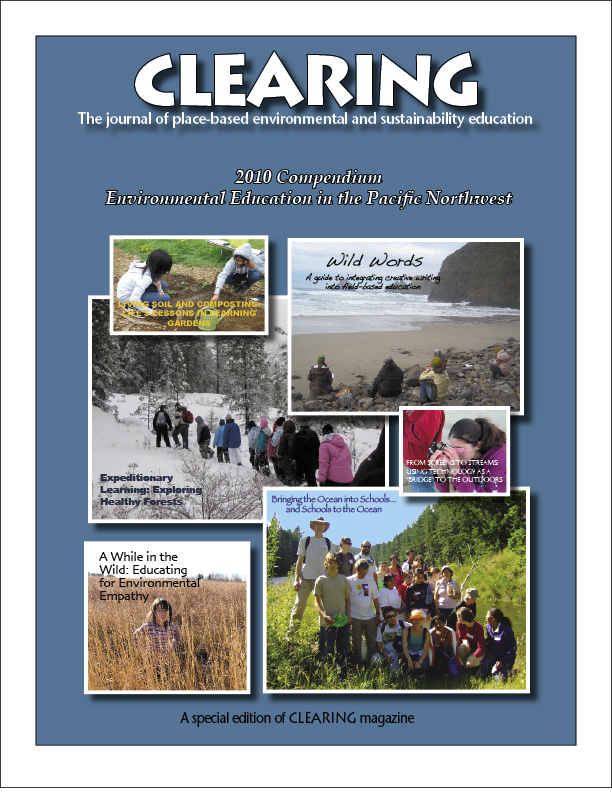
Learn the secrets of successful environmental education programs! Read the perspectives and opinions of experienced teachers! Discover new ideas that can turn your classroom into an innovative and dynamic hub of place-based learning! The Best of Clearing is full of fresh ideas and old wisdom to help you create powerful learning experiences for your students.

Jessica Levine
Gregory Smith,
Lindsay Huettman,
Jim Martin,