Wachstumshormone

slideshow_12xBy Clifford E. Knapp

The exploration of the educational potential of communities through direct experiences is not a new idea.  In 1912 naturalist, John Burroughs, wrote: “. . . The way of knowledge of Nature is the way of love and enjoyment, and is more surely found in the open air than in the schoolroom or the laboratory” (Burroughs, In Finch and Elder (Eds.), 1990, p. 275)  In 1915 educator and philosopher, John Dewey, re-published some earlier speeches in his book, The School and Society.  He wrote: “We cannot overlook the importance for educational purposes of the close and intimate acquaintance got with nature at first hand, with real things and materials, with the actual processes of their manipulation, and the knowledge of their social necessities and uses” (p. 11).  Why has it taken so long for educators to expand their concept of classrooms to include community outdoor laboratories?

Today, many innovative educators are venturing into the community to enrich the curriculum and to energize the instructional program and their own teaching lives.  Why are they doing this?

ALERT: You need to be a CLEARING subscriber to read the rest of this article. Join now to get your password.
(enter password then hit return button on your keyboard for best results)

snag 4 edit(1)By Robert Yager

There has never been a time when it is so clear that typical instruction wedded to textbooks and teacher lesson plans and characterized by discipline-bound classes throughout the school day must be changed. These conditions do not improve learning — they inhibit it.

Place-based education makes science, social studies, mathematics, reading, and the humanities more interesting. By integrating place into the school curriculum, learning can be seen as important for daily living: it deals with issues, enables students to participate in societal decisions, and can be related to economic improvement. Place-based education provides a real-world context that is missing from a prescribed curriculum, (i.e., strict adherence to a textbook, the recall of information or replication of specific skills that provide the instructional and assessment focus for 95 percent of typical instruction in most classrooms). Read more

The following is part 1 of an on-going discussion on place-based education topics between Gregory Smith of Lewis and Clark College and David Greenwood of Lakehead University in Thunder Bay, Ontario (formerly of Washington State University). You are invited to participate in this discussion and can add your comments through the reply box at the bottom of the post.

7/21/10

gregsmithHi David,

I’ve been meaning to touch base with you about my experience in Juneau doing a place-based education institute a month ago. What I encountered there raised some questions for me about whether it’s possible to marry the wisdom of Indigenous educational systems to what happens in Western schools, even though this underlies at least some of what I’m attempting to accomplish as I advocate for place- and community-based approaches. I’m wondering whether it is appropriate to link a goal-based meritocratic enterprise with a process of acculturation that is at base spiritual, humane, and ecological. As a result of an unspoken tension between me and the Tlingit elders and leaders who were part of the team that organized the institute, I found myself increasingly questioning the application of the goal- and accountability-dominated curriculum development process encountered in contemporary schools with the kinds of more open-ended and improvisational learning experiences that connect young people to community and place encountered in Indigenous societies. Read more

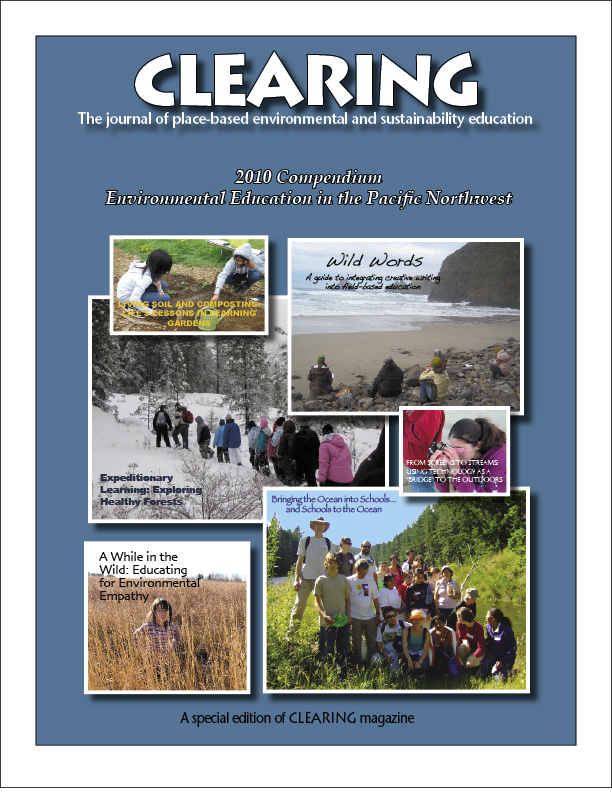
USFSlargelogoThe USDA Forest Service (Region 6) is the latest agency or organization to join the Clearing team as a partner/sponsor. Thanks to Sue Baker in the Hood River OR office and Susan Thomas in the Leavenworth WA office, the USFS and its Region 6 ranger districts will receive complimentary copies of the 2010 Compendium Edition of Clearing along with quarterly editions of the Clearing newsletter. In addition, Clearing will highlight USFS educational materials on the website and in future printed editions.

The US Forest Service Conservation Education program (CE) helps people of all ages understand and appreciate our country’s natural resources — and learn how to conserve those resources for future generations. Through structured educational experiences and activities targeted to varying age groups and populations, the USFS CE enables people to realize how natural resources and ecosystems affect each other and how resources can be used wisely.

Welcome to the USFS Region 6 and thank you!