
The Utility of Partnerships – Joseph Gale Elementary
Because clean water is part of daily life and it’s readily available, we often take it for granted. It’s easy to see why local utilities, wastewater included, don’t always come to mind as educational partners. In fact, many utilities are eager to partner with schools and community groups to provide relevant and valuable hands-on learning opportunities for students of all ages.
by Ely O’Connor
Clean Water Services

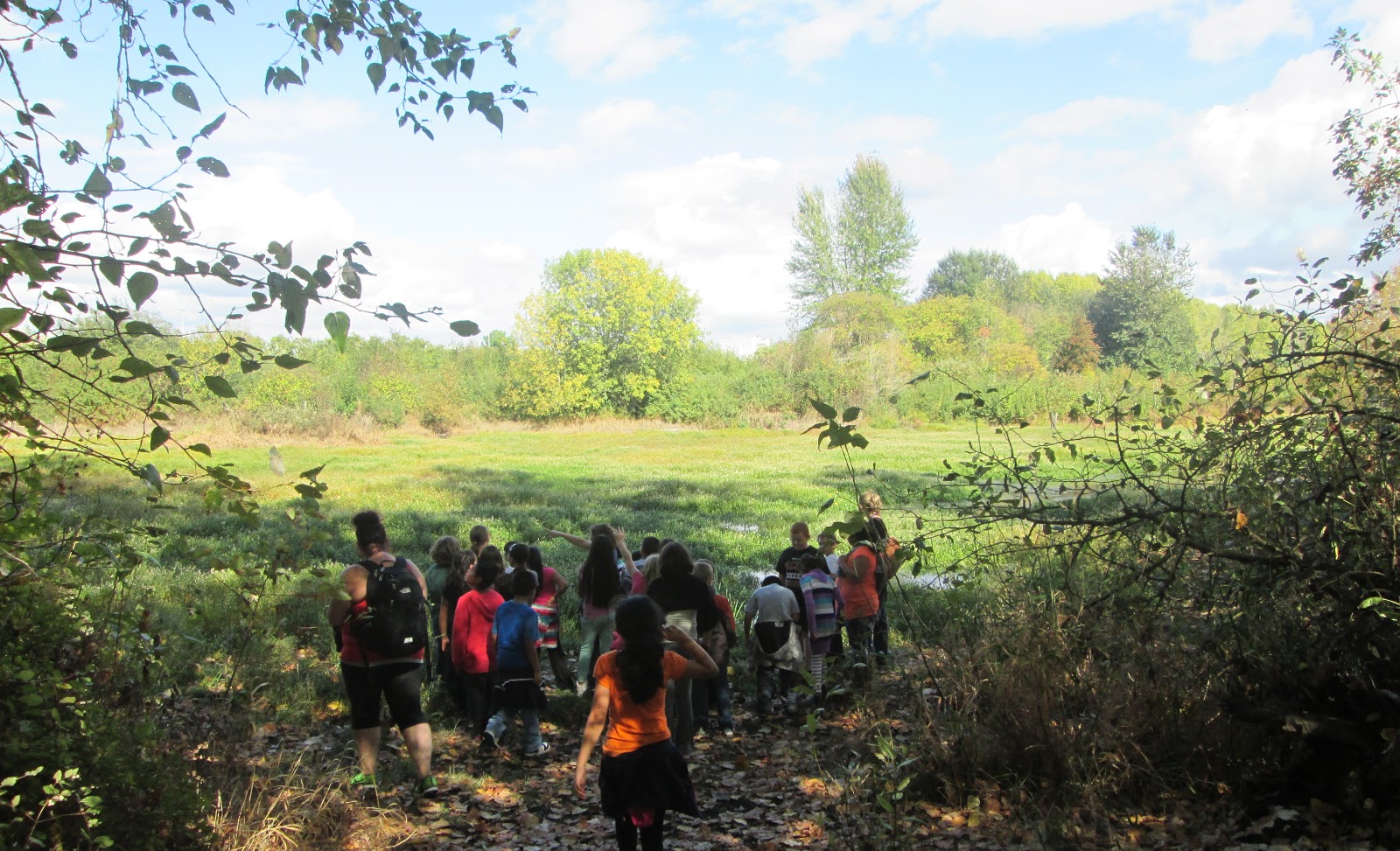
Joseph Gale students explore a marsh at Fernhill Wetlands as part of an erosion unit.
 ecause clean water is part of daily life and it’s readily available, we often take it for granted. It’s easy to see why local utilities, wastewater included, don’t always come to mind as educational partners. In fact, many utilities are eager to partner with schools and community groups to provide relevant and valuable hands-on learning opportunities for students of all ages.
Everything we do at Clean Water Services (CWS) aims to protect public health, while enhancing the natural environment Oregon’s Tualatin River Watershed. Combining science and nature, we work in partnership with others to safeguard the river’s health and vitality, ensure the economic success of our region and protect public health for more than 560,000 residents and businesses in urban Washington County.
Education is a big part of work and through participation in the Portland Metro STEM Partnership (PMSP), we’ve connected with several schools and classes that are seeking the very resources, expertise and experiences we offer. These partnerships have led to into the development of in-depth units, standards-aligned curriculum and hands-on experiences for students. Far from the one-off programming we seek to minimize.
Our partnership with the fourth grade classes at Joseph Gale Elementary in Forest Grove is one example of how non-formal educators can lend expertise and relevance to increase student understanding of complex subjects. Over the course of the 2014-15 school year, 60 fourth grade students participated in four classroom and four field experiences to investigate and understand human impacts on erosion in their watershed. To supplement teacher-led lessons, CWS staff led students on tours at Fernhill Wetlands and Forest Grove wastewater treatment facility (less than a mile from school), led field activities to measure erosion potential along a rural stream and identified and planted native species for erosion control. In class, CWS staff led lessons about the Tualatin Watershed, erosion cause and effect, explored a watershed model, and identified and planted native plant species on school grounds.

Beaverton and Forest Grove science teachers get a behind-the-scenes look at how we clean water.
CWS and Hillsboro Water staff also collaborated with the PMSP, Forest Grove and Beaverton School District science teachers to develop a water chemistry unit in 2014-15. The water professionals helped teachers work through lab logistics and protocol, with one Forest Grove teacher training in our lab with certified staff. On a professional development day ten Forest Grove and Beaverton chemistry teachers were co-trained on lab protocol and attended a specialized tour of our Rock Creek facility to learn more about the how we use chemistry (and other science disciplines) to clean water to nearly drinking water standards. In the spring nearly 400 chemistry students at Forest Grove, Aloha and Westview high schools participated in the newly developed unit. CWS staff also attended Forest Grove and Aloha science career fairs to talk about STEM and water careers.
This partnership brought capacity to our education and outreach efforts through leveraging resources. In the past, working directly with 400 students would have been a challenge.By training the teachers and assisting with curriculum development, we’ve extended our reach and supported the development of standards-based units. We love working directly with students when possible, but would definitely like to replicate the teacher training and support model.
Both of these partnerships brought the opportunity to engage hundreds of students and several teachers in our community in a way that meets our education goals and supports NGSS and STEM learning. We’ve also been able to use Clean Water Services resources and staff in a sustainable way to extend classroom learning and show real-world applications in the local community.
I would encourage looking for non-formal education partners inside your community but outside the norm. Connect with your local utilities, cities, business and non-profits to show students local examples and bring context to lessons.
To learn more about Clean Water Services’ education programs check out our Student Education Annual Report or contact Ely O’Connor.