
Know and Do What We Teach: How many times are we assigned to teach a subject we know little about?
by Jim Martin
CLEARING Special Contributor
 t a riparian ecology training for teachers a few years ago, I met two who epitomize a perennial problem in education in America. One of the teachers was in her third year of teaching, said she had no background in science, was never trained for teaching it, but was assigned to teach all of the 6th grade science in her middle school. The other was a teacher who had been a fisheries biologist for several years, and was now teaching high school science. Two teachers, each of whom is assumed will deliver equally effective, student-empowering curricula in their schools. Who are assumed to be teaching at the same level of experience and expertise. How do we rationalize this? How do we deal with it?
Many teachers who lack confidence in teaching the content they are assigned forces them to simply use and parrot the instructions in teachers’ editions of their assigned curricular materials. If we are simply in the schools to prepare our students for the standards tests they will take, adhering to the status quo may be able to make the attempt; although, to date, this effort has produced no nation-wide positive result. But, if we are in schools to involve and invest our students in authentic and challenging concept-based curriculum, and to deliver our curricula in a way which empowers them as persons, then we all need to comprehend the concepts we teach at a level which makes us comfortable in determining our own ways to deliver our curricula. The only way to do that is to know and do what we teach.
As long as we are able to build a learning environment which involves and invests our students in their learnings and empowers them as persons, their brains will do the work. While there are many reasons posited for the poor performance of US students compared with their global peers, assumptions about student capacity based on demographics ought not to matter, not be a reason for poor performance; the brain is an autonomous learning machine. If we allow it.
Why should I want more than a good set of published curricular materials?
All teachers of empowered students that I’ve observed have a content background strong enough to allow them to design their own curricular deliveries. And their students, regardless of demographics, respond to this in a positive, participating way. I’ve also observed teachers with little or no background in the curricular content and/or grade level they are assigned to teach become exceptional teachers when they receive competent mentoring in their classrooms while they are teaching. Just as with their students, these teachers’ brains became autonomous learning machines when they were allowed to. Our expectations re teachers’ preparation for the content they are assigned to teach is a strong indicator that many of us do not allow that. They are assigned to teach what they are assigned to teach. Beyond that, most receive precious little support in the way of developing professional competence in their assigned content area.
Would we accept a world in which only about half of automobile mechanics have training to repair the motors they work on? Where half of dentists have the training to perform a root canal on their root canal patients? How about only half of surgeons with training for the surgeries they perform? Only half of lawyers with training for the cases they proceed with in the court? Half the baristas with no training for the coffees they produce in the coffee shops where they work? We have, and assume, the right to people who have had effective training for the work they perform. Except for teachers. It’s almost as if there is an assumption that teachers can “just do it.” In fact, I’ve heard this claim. More than once.
So, why are we so complacent about having teachers in classrooms who may be only marginally trained in the content they deliver? Jaime Escalante taught calculus to students at Garfield High School in Los Angeles, where 85 percent of the students were eligible for free or reduced-fee meals, and faculty morale was low (Scientific American, Aug 2011, p. 14: Stand and Deliver). His unpopular, to some, attitude toward his students’ brains’ capacity for learning was displayed in a banner in his classroom which declared, “Calculus does not have to be made easy – It is easy already”. In spite of opposition from the school administration and some faculty to his teaching, more of his students took the AP calculus exam than at all but three other public schools in the nation. Two thirds of his students passed the exam. He possessed a background in calculus which allowed him to develop and execute a very clear demonstration that the brain is an autonomous learning machine when we allow it. And proved it.
In a recent article, Climate confusion among U.S. teachers: Teachers’ knowledge and values can hinder climate education, published in the 12 February 2016 issue of Science magazine, the authors report that fewer than 25% of teachers have the training they need to teach the basics of global warming. This, in spite of the fact that climate change may be the most important challenge that today’s students and their children will face. Why aren’t schools allowed to provide the training their teachers need to become more effective teachers of climate change in their classrooms? A large fraction of the business world does just that. Especially when there is a demonstrated authentic need for it.
What do I need in addition to good curricular materials to better prepare my students for their future?
A suggestion: I submit that we need to work together to develop an effective method to ensure that teachers have access to the training and support they need to teach inquiry-based science in their classrooms. Every day. We don’t think of students as the people who will set our nation’s place among the other nations in the world, but they are. We need more than a small fraction of K-12 students who excel in school. My experience tells me that nearly all students have the capacity to either excel, or do very well in school. Dysfunctional families can certainly hold their children back, and schools have very little influence over what happens at home. But, they ought to have influence over what happens at school. That’s where their power lies.
Schools, can, and do, produce environments in which all of their students can excel, or at the least, do very well. For instance, one school I’ve known for a long time does just that. The Jane Goodall Environmental Middle School (JGEMS), a public charter school in Salem, OR, does that consistently every year. Entering students are selected via a lottery which covers Salem’s demographic spectrum. While the faculty don’t focus on the standards, each year 100% of their students pass the standards exams, 90% or more at the two highest levels. Oddly enough, all of their teachers have strong backgrounds in the content they teach.
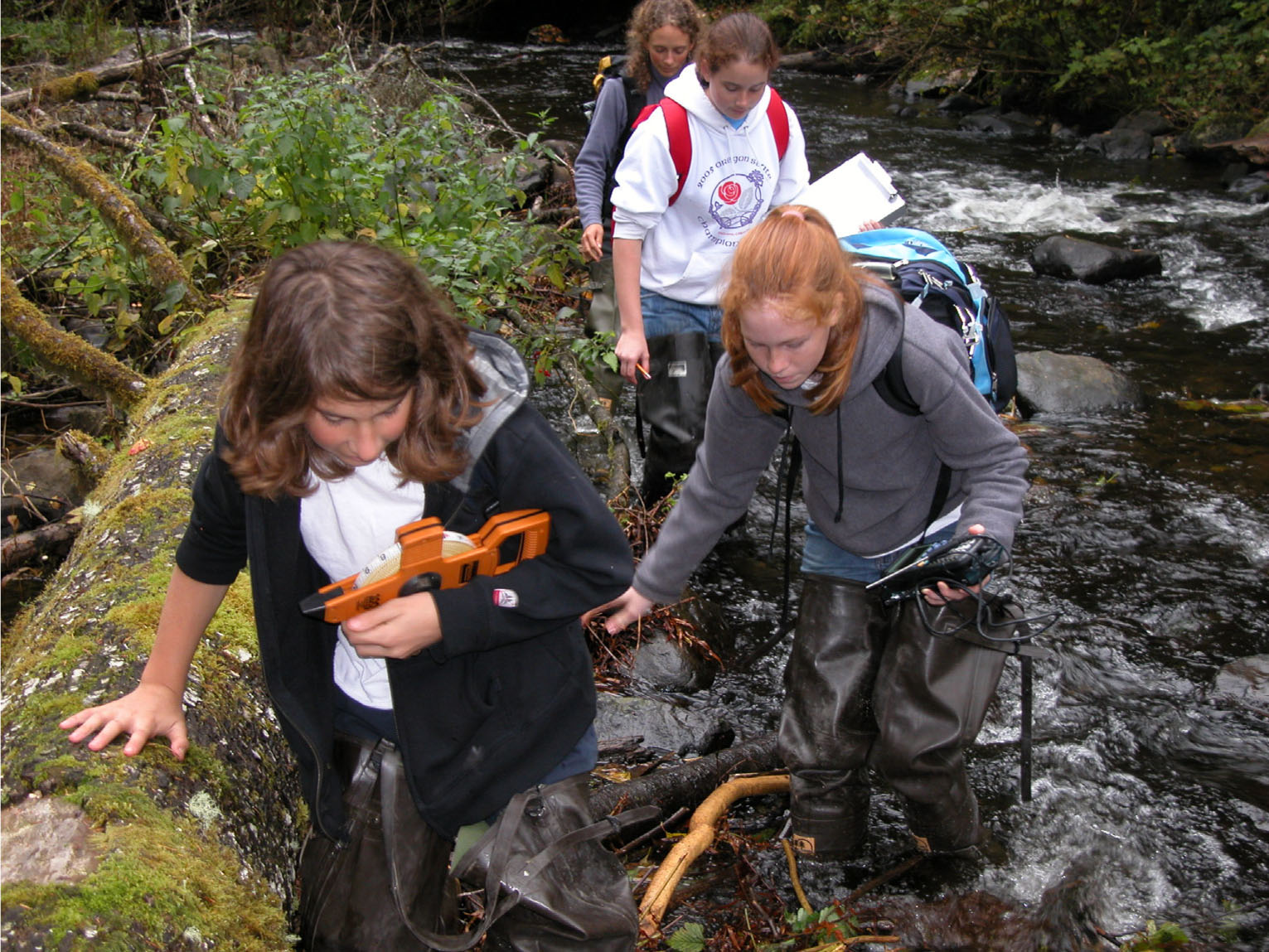
In many of these cases, teachers have engaged in summer workshops and institutes which deliver hands-on experience in doing science inquiries they have conceived, designed, and executed in natural environments, and using those experiences to develop in-depth content knowledge of the subject of their inquiries. This is a context in which regional environmental educators and experienced teachers can collaborate to plan and execute workshops and institutes which can provide the training and support to produce classrooms which are facilitated by teachers who are experienced in science inquiry and have deep knowledge of the content they teach. And which deliver students who are involved and invested in their educations; and empowered as persons. A strong content and process background gives teachers the confidence it takes to deliver a student-centered, active-learning based curriculum. Something we all need to learn to do. Well.
How can you help?
 This is a regular feature by CLEARING “master teacher” Jim Martin that explores how environmental educators can help classroom teachers get away from the pressure to teach to the standardized tests, and how teachers can gain the confidence to go into the world outside of their classrooms for a substantial piece of their curricula. See the other installments here, or search Categories for “Jim Martin.”